How to Make Ginger Bug
Cultivate a ginger bug starter to make naturally carbonated sodas at home. Feed it ginger and sugar to grow a fizzy fermentation culture.
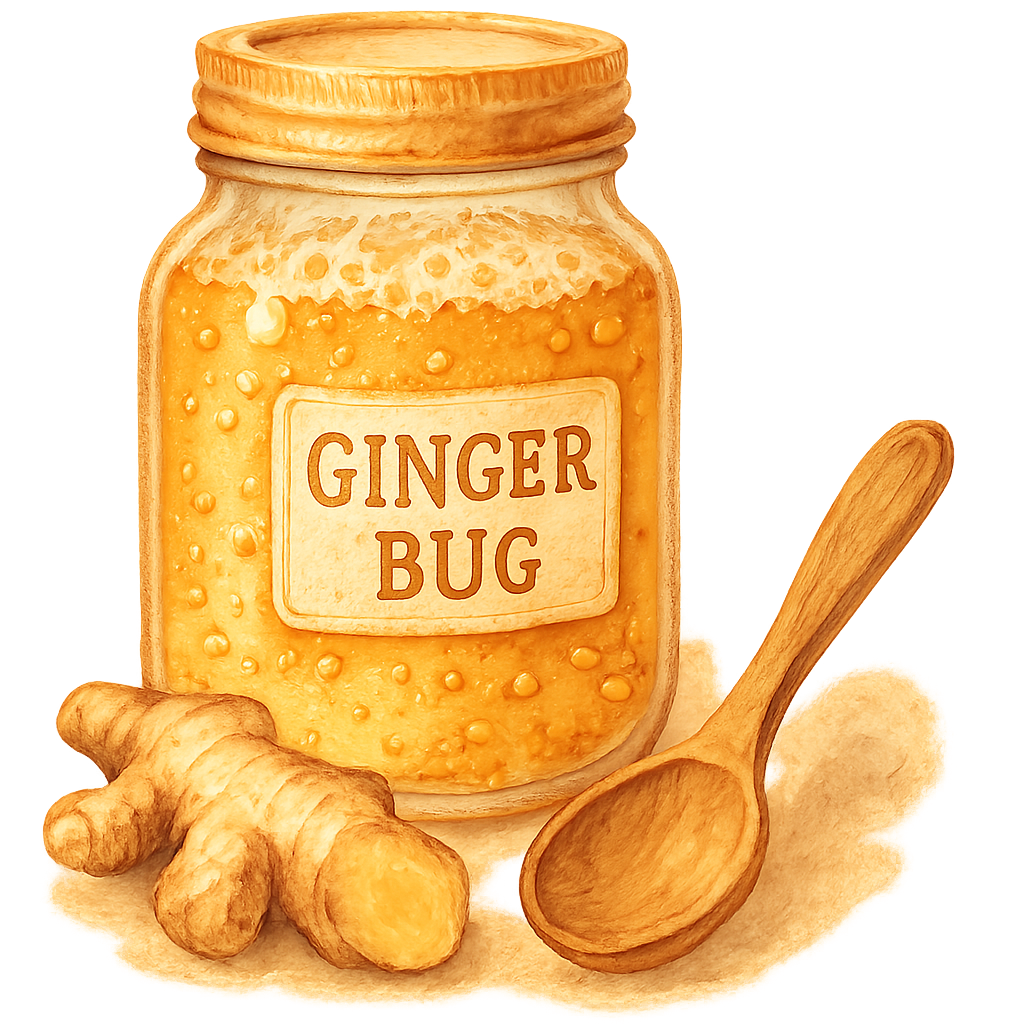
A ginger bug is a wild-fermented starter culture made from fresh ginger, sugar, and water. Wild yeasts and bacteria that live on the skin of fresh ginger colonize the mixture over 5–10 days, creating a bubbly, living culture capable of naturally carbonating homemade sodas, ginger beer, and fruit drinks. Once established, a ginger bug is essentially indefinite — feed it weekly and it will keep producing batch after batch of naturally fizzy, probiotic-rich beverages.
Equipment
- Glass jar (16–32 oz / 500ml–1L)
- Small plate or loose lid (breathable cover — not airtight)
- Kitchen scale or measuring spoons
- Wooden spoon or silicone spatula
- Rubber band (to mark liquid level)
- Fine mesh strainer or cheesecloth
- Flip-top glass bottles (Grolsch-style) or plastic screw-cap soda bottles for second fermentation
- Funnel
Ingredients
- Fresh ginger root — organic preferred, unpeeled (leave the skin on)
- Granulated white cane sugar
- Filtered or dechlorinated water
- Fruit juice, ginger tea, or flavored sugar-water (for making soda)
- Lemon or lime juice (for ginger beer)
Workflow
Day 1: Initial Setup
24 hoursChoose fresh, organic ginger
Select firm, plump fresh ginger root. Organic (or unsprayed) ginger is strongly preferred because wild yeasts and bacteria living on the skin are what drive fermentation. Conventionally grown ginger may be irradiated, which kills the microflora needed to start the culture.
Conventionally grown ginger may be irradiated. Irradiation kills the wild yeast on the skin and will prevent the bug from activating.
Grate ginger with skin on
Grate 2 tablespoons (about 15–20g) of fresh ginger — skin and all — into your clean jar. Use the fine side of a box grater or a microplane to release the juices.
Add sugar and water
Add 2 tablespoons (25g) of granulated white sugar to the jar, then pour in 2 cups (480ml) of filtered, room-temperature water (68–75°F / 20–24°C). Stir vigorously until the sugar is fully dissolved.
Chlorinated or chloraminated tap water will inhibit or kill wild cultures. If your tap water contains chloramine (common in city water), use a carbon filter or bottled water — chloramine does not off-gas like chlorine.
Mark level and cover
Stir everything well, then place a rubber band around the jar at the current liquid level to track rise. Cover loosely with a small plate, cloth, or lid placed on top — not sealed airtight.
Ready When
Days 2–5: Daily Feedings
4 daysAdd grated ginger
Every 24 hours, add 1 tablespoon (7–10g) of freshly grated ginger (skin on) to the jar. Consistency matters more than precision — daily feedings at roughly the same time each day work best.
Add sugar
Add 1 tablespoon (12g) of granulated sugar to the jar alongside the ginger.
Stir vigorously
Stir the bug briskly for 30–60 seconds to incorporate some oxygen and distribute the cultures throughout the liquid. In the early stages, active stirring helps wake up yeasts that benefit from some aeration.
Observe activity
Check for bubbles along the sides and top, a slightly yeasty or gingery smell, and any liquid rise above the rubber band mark. The liquid will gradually become cloudier and more golden as fermentation progresses.
Ready When
Readiness Test (Days 5–7)
1 dayVigorous bubble test
Stir the bug briskly. Within 30 seconds you should see an active froth of bubbles that persists for at least a minute. If bubbles are sluggish or disappear immediately, feed again and wait another day before testing.
Smell test
The bug should smell pleasantly yeasty and gingery — similar to ginger beer or ginger ale with a faint bread-yeast note. No sharp alcohol smell, no rotten odor, no harsh vinegary note.
Taste test
Dip a clean spoon and taste a small amount. It should be mildly sweet, gingery, and lightly fizzy on the tongue. Slight sourness is fine and desirable. If it tastes flat and very sweet with no tang, it needs more time.
Ready When
Making Ginger Beer (Second Fermentation)
1–3 daysBrew ginger tea base
Bring 4 cups (950ml) of water to a boil. Add 2–4 tablespoons of freshly grated ginger. Simmer for 5 minutes, then remove from heat and stir in half to three-quarters cup (100–150g) of sugar until dissolved. Add the remaining 4 cups (950ml) of cold water to bring the mixture to room temperature.
Add lemon juice
Squeeze in the juice of 1–2 lemons (about 2–4 tablespoons). Citric acid lowers the pH, creating a more favorable environment for yeast and adding brightness and freshness to the finished drink.
Add ginger bug liquid
Strain one-quarter cup (60ml) of liquid from your ginger bug through a fine mesh strainer into the cooled ginger tea. Reserve the remaining ginger solids and liquid in your jar — this is your ongoing starter.
Bottle and carbonate
Pour the mixture through a funnel into clean flip-top glass bottles or plastic screw-top soda bottles. Leave 1–2 inches of headspace. Seal tightly and leave at room temperature (68–78°F / 20–26°C) for 1–3 days. Burp plastic bottles once or twice daily by briefly opening to gauge pressure.
Do not use regular mason jars for second fermentation — CO2 pressure can build to unsafe levels and cause breakage
Never leave bottles unsealed-checked for more than 48 hours in warm weather
Always open bottles slowly over a sink, pointing away from your face
Refrigerate when ready
Once the plastic bottle feels firm and hard (or you hear a satisfying hiss when slowly cracking the lid of a glass bottle), move bottles to the refrigerator. Cold slows fermentation to a near stop. Consume within 2–4 weeks for best flavor.
Ready When
Ongoing Bug Maintenance
Room temperature maintenance
If brewing frequently (weekly or more), keep the bug at room temperature and feed daily with 1 tablespoon grated ginger + 1 tablespoon sugar. An active room-temperature bug is ready to use again within 24–48 hours of a fresh feeding.
Refrigerator storage
If brewing infrequently, store the bug in the fridge. Feed once a week with 1 tablespoon grated ginger + 1 tablespoon sugar. Bring to room temperature and feed for 2–3 days before using in a new batch.
Replenish after each use
After drawing off liquid for a batch of soda, replenish the bug by adding one-quarter cup fresh filtered water + 1 tablespoon grated ginger + 1 tablespoon sugar. Stir and allow to reactivate.
Troubleshooting
Common issues and how to fix them. Something look off? Find your symptom below.
Food Safety
Temperature
Always cool ginger tea or sugar-water to room temperature (below 80°F / 27°C) before adding bug liquid. Heat above 95°F kills the wild yeast and bacteria in the culture.
Keep the ginger bug at 68–80°F (20–27°C). Below 65°F fermentation stalls; above 85°F can favor unwanted organisms.
Equipment
Use only pressure-rated bottles for second fermentation (swing-top glass or screw-cap bottles designed for carbonation). Never use regular mason jars — CO2 pressure can cause them to shatter.
Always open fermented soda bottles slowly over a sink, pointing away from your face. Over-carbonated bottles can geyser when opened.
Storage
Burp bottles (open briefly to release excess pressure) once daily during room-temperature second fermentation. Never leave sealed bottles unattended for more than 48 hours in warm conditions.
Finished ginger beer contains 0.5–2% ABV due to natural yeast activity. Do not serve to children or pregnant individuals without disclosure.
Hygiene
Use organic ginger when possible. Conventionally grown ginger may be irradiated or treated with fungicides that kill the wild cultures needed for fermentation.
Use filtered or non-chlorinated water. Chlorine and chloramine in tap water inhibit or kill the wild fermentation cultures.
When to Discard
Fuzzy mold growth (any color)
Fuzzy, raised mold on the surface of the ginger bug means contamination. Unlike flat kahm yeast film, true mold is three-dimensional and fuzzy. Discard the entire culture and start fresh with a clean jar and fresh organic ginger.
Putrid or rotten smell
A healthy ginger bug smells yeasty, gingery, and mildly sour. A putrid, sulphurous, or truly rotten smell indicates harmful bacteria have taken over the culture. Discard immediately.
No activity after 7+ days with organic ginger in warm conditions
If the bug shows absolutely no bubbling or smell change after a week of daily feedings at warm temperatures (75°F+), the ginger is likely irradiated. Source fresh organic ginger from a different supplier and start over.
Storage Guidelines
Room Temperature
Active ginger bug: feed daily at room temperature (68–80°F). Bottled sodas: 1–3 days at room temperature for carbonation, then refrigerate immediately.
Refrigerated
Dormant ginger bug: feed once weekly. Finished sodas: consume within 2–3 weeks refrigerated for best flavor and carbonation.
Frozen
Not typically recommended for the active culture. If needed, freeze with extra sugar as a cryoprotectant and revive slowly with daily feedings at room temperature.
Shelf Life
Finished sodas: 2–3 weeks refrigerated. Ginger bug culture: indefinite with regular feeding.
Flavor Variations
Once you have mastered the basics, try these flavor combinations to take your ferments to the next level.
Classic Spicy Ginger Beer
A proper home-brewed ginger beer with real ginger heat, lemon brightness, and natural carbonation — the gold standard for ginger bug sodas.
Ingredients
- 4 cups water
- Half cup cane sugar
- 3 tablespoons fresh ginger, grated
- 3 tablespoons fresh lemon juice
- Quarter cup active ginger bug liquid
Simmer ginger in water with sugar to extract flavor, then cool completely before adding bug liquid.
Taste your ginger tea before bottling — it should be slightly more gingery than you want the finished drink, as fermentation mellows some heat.
Old-Fashioned Root Beer
A homemade root beer using genuine botanicals — safrole-free sassafras extract, sarsaparilla, licorice root, and vanilla — fermented naturally with ginger bug.
Ingredients
- 4 cups water
- Half cup brown sugar or molasses
- 1 tablespoon safrole-free sassafras bark extract
- 1 teaspoon sarsaparilla root
- Half teaspoon licorice root
- Half teaspoon pure vanilla extract
- Quarter cup active ginger bug liquid
Use only safrole-free sassafras extract — regular sassafras bark contains safrole, which is a regulated compound.
Simmer herbs in water for 20 minutes, strain, dissolve sugar, cool completely, then add ginger bug.
Vanilla Cream Soda
A delicately sweet, vanilla-scented natural soda with a subtle tang from the ginger bug and smooth richness from real vanilla extract.
Ingredients
- 4 cups filtered water
- Half cup cane sugar
- 1.5 teaspoons pure vanilla extract
- Quarter cup active ginger bug liquid
- Optional: 1 tablespoon coconut cream for richness
Use a mature, well-established bug for best carbonation without ginger flavor dominating.
Chill completely before serving over ice — cold dramatically improves the vanilla flavor.
Wild Berry Natural Soda
Deeply fruity and vibrantly colored — mixed berry juice combined with ginger bug creates a probiotic natural soda that tastes like summer.
Ingredients
- 2 cups mixed berry juice (blended and strained from fresh or frozen berries)
- 2 cups filtered water
- Quarter cup cane sugar
- Quarter cup active ginger bug liquid
- 1 tablespoon lemon juice
Combine berry juice with sugar water and cool completely before adding ginger bug.
Berry sodas are prone to sediment from berry fiber — shake gently before pouring.
Track Your Ginger Bug with FermentBuddy
Get smart timers, guided workflows, and real-time troubleshooting for your ginger bug and all your fermentation projects.